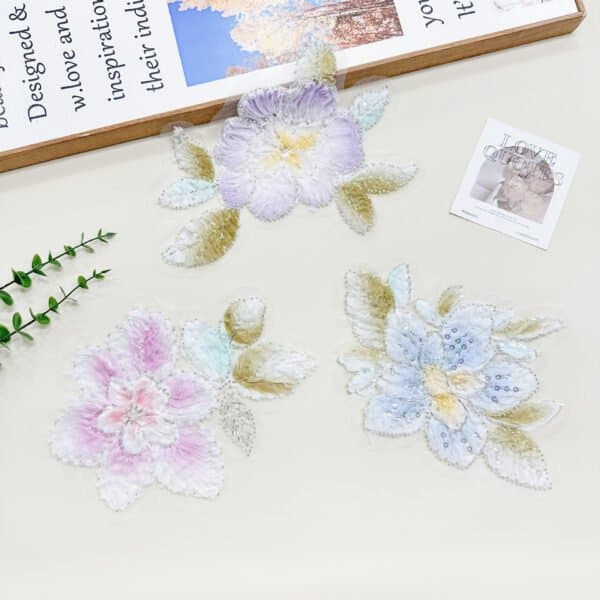
Compare 3D lace applique and flat embroidered applique by appearance, weight, durability, sewing, care, cost drivers and best garment applications.
Quick comparison for sourcing teams
A 3D lace applique uses layered, folded or individually attached elements to lift flowers and details away from the base. A flat embroidered applique uses stitched motifs that remain comparatively close to mesh, organza or another foundation.
For a hero bodice, train or statement sleeve, 3D construction can create the strongest visual focus. For veils, close-fitting sleeves, seam crossings and repeated production details, a flatter motif often gives more predictable handling.
Start with the intended gown and browse the relevant bridal lace sourcing range before comparing isolated motifs.
Appearance and motif definition
Three-dimensional petals create highlights and shadows as the wearer moves, so even a tonal ivory motif can appear detailed. The result is suited to floral focal points and couture placement, but petal direction must be controlled during packing and attachment.
Flat embroidery communicates detail through stitch density, thread direction, color and negative space. It can still feel intricate while maintaining a cleaner silhouette under veils, overlays or fitted garment layers.
Review real raised-petal references and procurement fields on the 3D flower applique page.
Weight, drape and comfort
Layered petals, beads and hand-applied components add local weight. Place them where the garment base can support that load and test whether the reverse side needs lining, especially on illusion tulle or close-to-skin areas.
Flat appliques normally distribute weight more evenly and create less bulk. They are often easier on soft sleeves, lightweight veils and garments that must fold closely, although dense stitching can still feel stiff if not sampled on the final base.
Sewing, placement and production repeatability
A 3D motif needs careful handling so petals are not trapped under stitches. Sewing teams may secure the foundation and selected internal points while protecting raised elements. Matched left-right sets should be labeled and packed by orientation.
Flat applique edges are generally easier to baste, machine-stitch or hand-sew around curves and seams. Whichever construction is selected, provide a placement map with motif code, direction, quantity per garment and fixed measurement points.
For lower-profile motifs and stitched bases, compare the current embroidery lace collection.
Durability, care and packing
Raised petals and embellishments face more abrasion during sewing, wear, cleaning and transport. Test attachment strength, snag risk and recovery after packing, then use protective separation where motifs could catch on one another.
Flat embroidery has fewer protruding elements, which can simplify packing and routine handling. Durability still depends on the base, cut edge, thread density and attachment method, so the approved physical sample remains the inspection standard.
MOQ, cost and lead-time drivers
Cost is driven by motif size, stitch count, number of layers, hand assembly, embellishment, backing, matching and order quantity. A 3D applique is usually more expensive, more complex to sample and more labor-intensive to sew, but the actual result depends on the design; compare the real construction rather than assuming one label determines price.
The MOQ for VELORACE LACE 3D flower appliques is 10 pieces. Sample Time: Confirmed after design review. Bulk Lead Time: Confirmed after design review. Artwork, materials, handwork, quantity and destination must be reviewed before a schedule is approved.
Which applique should you choose?
Choose 3D lace applique for protected focal areas, dimensional bridal florals, couture gowns and accessories where texture is central to the design. Choose flat embroidered applique for lighter garments, veil borders, seam-spanning motifs, close-fitting areas and programs that prioritize smooth packing and repeatability.
If the garment uses both, build a system: place hero 3D flowers at focal points and use related flat leaves or connectors to graduate the design. Request both samples in the same color family and assess them together on the final fabric before bulk approval.
Once the construction is selected, send artwork, dimensions, placement and quantity through the custom design workflow.